Forecasting and Quantification of Health Commodities: Key Concepts and Methods
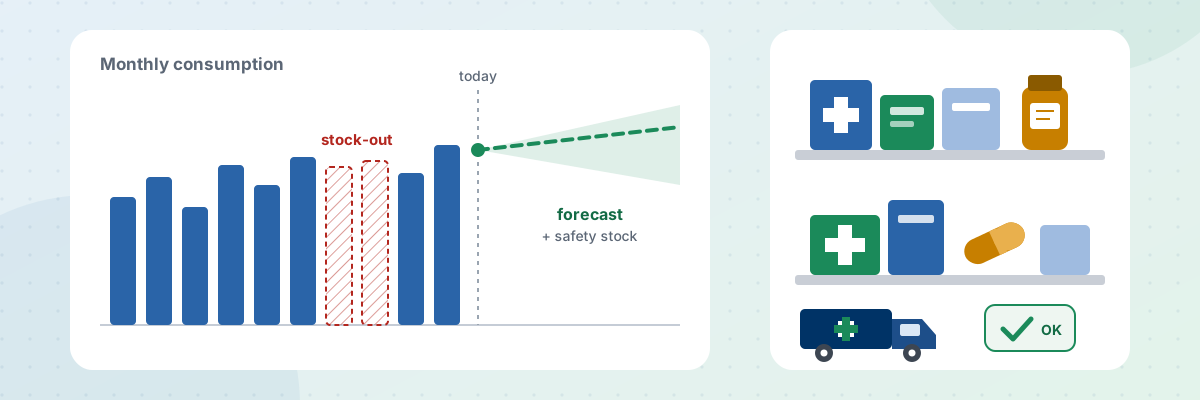
Health programmes must estimate how much of each medicine, vaccine and diagnostic product to procure. Under-estimation causes stock-outs; over-estimation causes expiry and wasted funds.
This article summarises the core concepts of the online course on forecasting and quantifying medicines and health products offered by i+academy. All credit belongs to the course; readers seeking a deeper understanding are encouraged to take the course.
Decision, forecasting and quantification
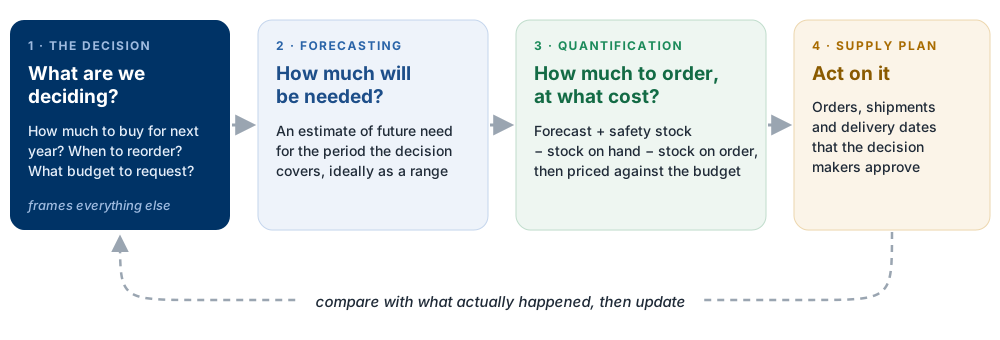
- Decision: what is being decided, such as the annual procurement quantity or the budget request.
- Forecasting: estimating how much will be needed over the decision period.
- Quantification: converting the forecast into the quantity to procure and its cost.
Position in the supply chain
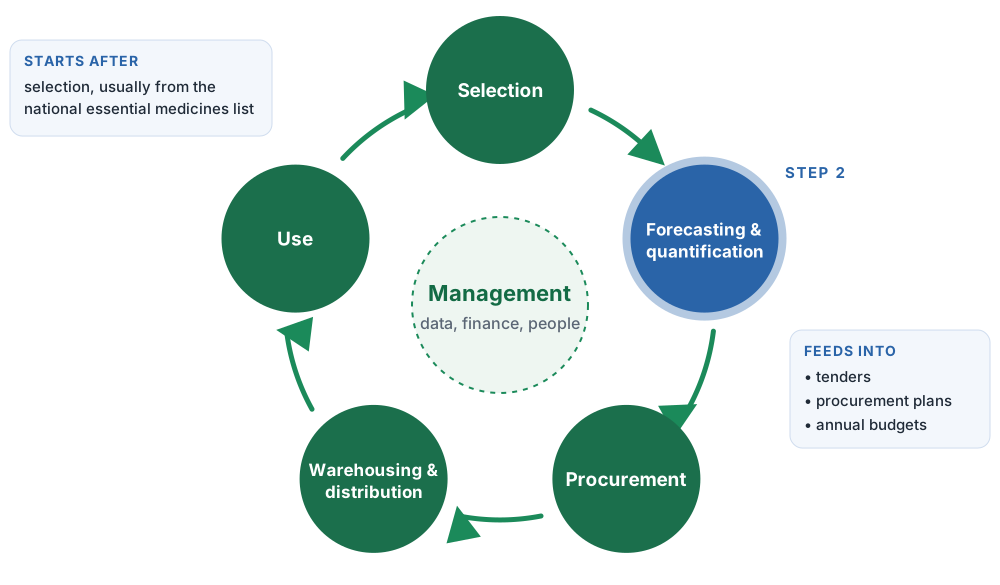
- Follows selection, typically from the national essential medicines list.
- Precedes procurement, distribution and use.
- Its outputs drive tenders, procurement plans and budgets.
Scoping questions
Adapted from Prof. Bahman Rostami-Tabar’s forecast scoping framework, the following questions should be addressed before choosing a method:
- Decision: which decision does the estimate support, over what period?
- Units: tablets, treatment courses, doses or tests?
- Lead time: the forecast must extend beyond the delivery time.
- Risk: if a stock-out is worse than overstock, use a range and safety stock.
- Data censoring: do stock-outs hide true demand?
- Structural change: is anything new (a vaccine, service or guideline)?
Key terms
Stock and supply terms
| Term | Definition |
|---|---|
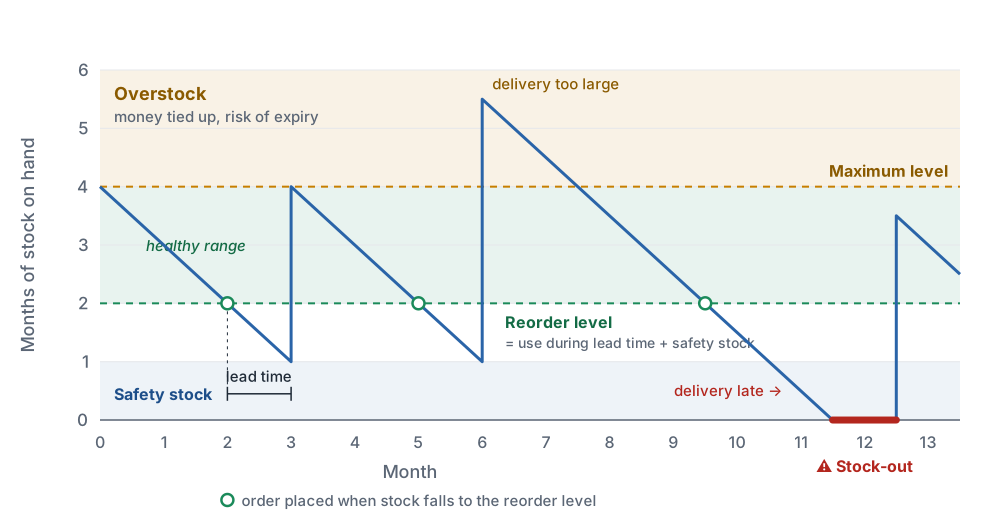
| Stock on hand | Usable stock available now, excluding stock that will expire before use. |
| Stock on order | Stock ordered but not yet received. |
| Months of stock | Stock on hand ÷ average monthly consumption. |
| Lead time | Time from placing an order to the stock being available. |
| Procurement period | The period an order must cover until the next delivery. |
| Safety (buffer) stock | Reserve stock for delays or demand surges. |
| Reorder level | Consumption during the lead time + safety stock. |
| Maximum stock level | Upper limit set by shelf life, storage and funds. |
| Stock-out / overstock | No stock at all / stock above the maximum level. |
Consumption method terms
| Term | Definition |
|---|---|
| Consumption | Quantity dispensed to patients. |
| Issues | Quantity supplied from a store to lower levels. |
| Demand | Consumption plus unmet need during stock-outs. |
| Average monthly consumption | Mean monthly consumption over months in stock. |
| Adjusted consumption | Consumption corrected for stock-outs and missing reports. |
| Reporting rate | Share of expected facility reports received. |
Morbidity method terms
| Term | Definition |
|---|---|
| Incidence | New cases in a period, usually per 1,000 people per year; used for acute conditions (e.g. malaria). |
| Prevalence | Share of the population with a condition at a point in time; used for chronic conditions (e.g. HIV). |
| Treatment episode | A patient contact requiring one full standard course of treatment. |
| Standard treatment guideline | National recommendation on medicine, dose, frequency and duration. |
| Quantity per episode | Dose × frequency × duration. |
| Care-seeking rate | Share of cases that present at the facilities supplied. |
Demographic method terms
| Term | Definition |
|---|---|
| Target population | The group a programme serves (e.g. infants, women of reproductive age). |
| Surviving infants | Infants who reach their first birthday; the usual base for childhood vaccines. |
| Coverage | Share of the target population expected to be reached. |
| Wastage rate | Share of supplied doses not administered. |
| Wastage factor | 1 ÷ (1 − wastage rate); 10% wastage gives 1.11. |
| Contraceptive prevalence rate | Share of women of reproductive age using contraception. |
| Method mix | Distribution of users across contraceptive methods. |
| Cycle | One month’s supply of oral pills (28 tablets); 13 cycles per user per year. |
| Couple-years of protection | Contraceptive protection for one year; e.g. 15 pill cycles = 1. |
Other method terms
| Term | Definition |
|---|---|
| Service statistics | Counts of services delivered, such as visits or tests. |
| Testing policy | Rule defining who should be tested. |
| Proxy consumption | Consumption of a comparable site, scaled to the target site. |
| Patient contact | One patient interaction; the unit of budget-based projection. |
| VEN classification | Vital, essential or non-essential; used to prioritise. |
Quantification methods
Select a method to open its step-by-step guide.
Based onPast consumption
Suitable forEstablished medicines, routine vaccines, contraceptives
LimitationDistorted by stock-outs; unusable for new products
Based onExpected cases × standard treatment
Suitable forDisease-specific medicines; new treatments or guidelines
LimitationNeeds reliable disease data; tends to overestimate
Based onTarget population × coverage × need per person
Suitable forVaccines (especially new ones) and family planning
LimitationOutdated census data and optimistic coverage
Service statisticsDiagnostics such as malaria rapid diagnostic tests (RDTs)
Proxy consumptionNew facilities or missing reports
Budget-based projectionAffordability and prioritisation
Selecting a method
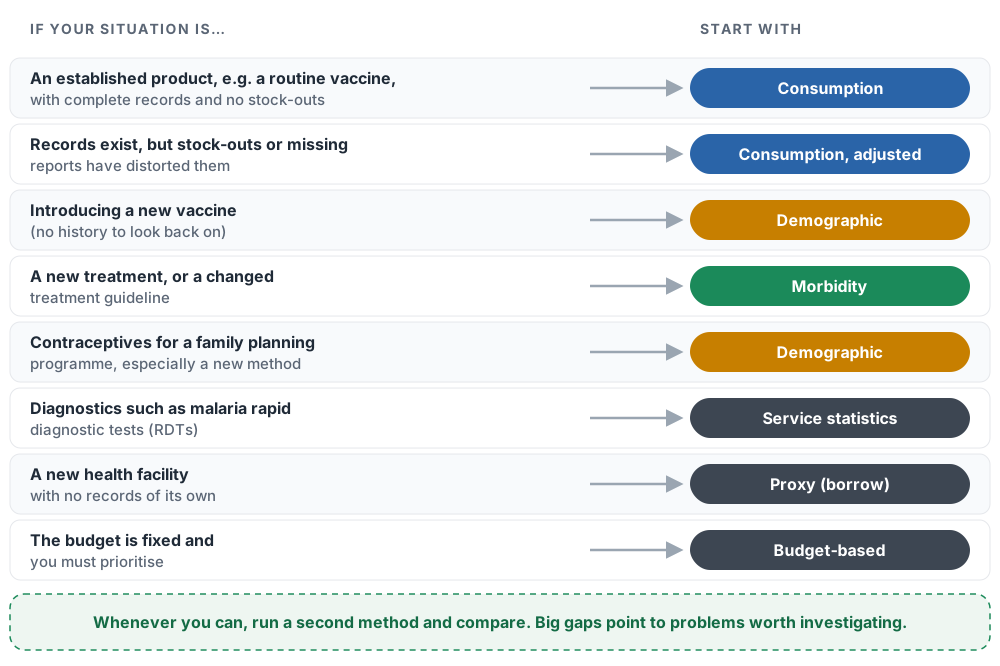
- No single method is best in all situations.
- Triangulate with at least two methods where data allow.
- Investigate large differences before ordering.
From forecast to procurement quantity
The same formula applies to every method:
Then cost the order, compare it with the budget and schedule deliveries.
The content of this article is based on the online course on forecasting and quantifying medicines and health products offered by i+academy, and all credit for the concepts presented here belongs to the course and its facilitators. For a more complete understanding, including practical exercises and the full quantification process, readers are encouraged to take the course: enrol in the course on i+academy.