The system is always in exactly one state at any given time step.
The next state depends only on the current state, not on the past (Markov property).
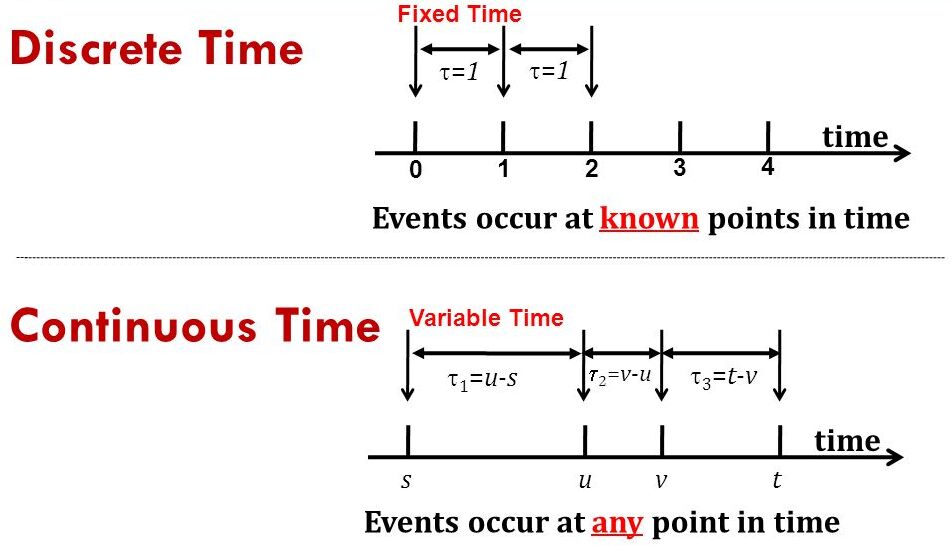
Transitions happen at fixed, regular time steps.
Transition probabilities stay the same over time.
Recap: State Space and Parameter Space
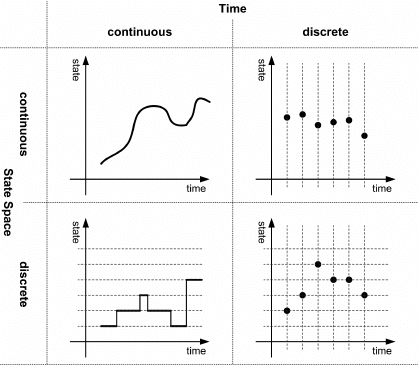
Recap: Discrete MC Vs Continuous MC
Outline
Recap
Continuous Time Markov Chains
Lab Activity: Part 1 – CTMC (Vaccine Observation Room)
Queueing Theory
Lab Activity: Part 2 – Queueing Theory (Check-In Desk)
Continuous Time Markov Chains (CTMC)
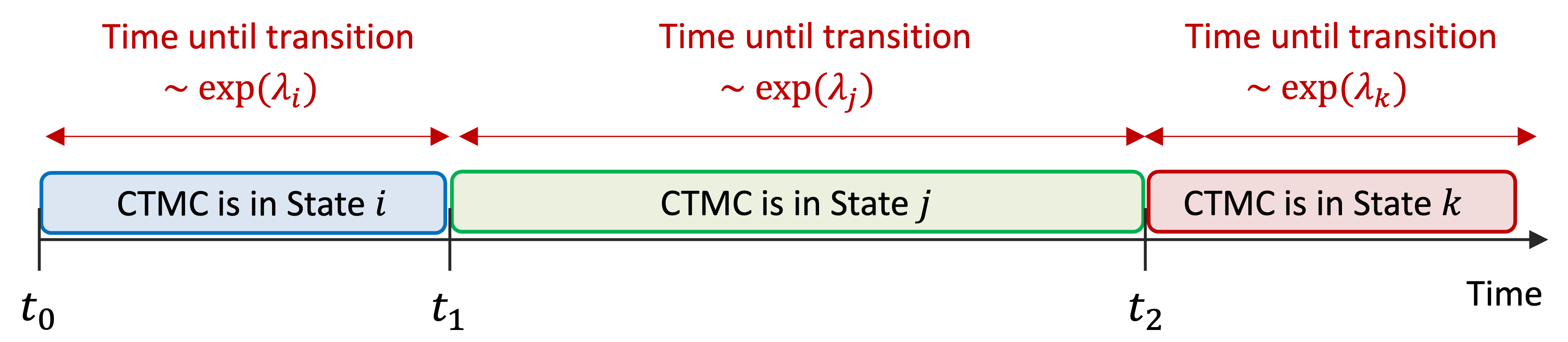
In a continuous-time Markov chain (CTMC), the system state can change at any point on the continuous time axis.
Exponential Timing in CTMCs
Assumption: In a Continuous-Time Markov Chain (CTMC), the time until the next state transition is modeled as a random variable \[
T \sim \text{Exponential}(\lambda)
\]
where:
The future depends only on the current state\(X(T)\), not on the history.
CTMC Example: Managing a Tiny Shop’s Flow
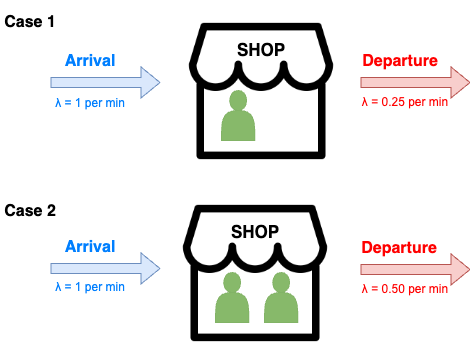
Imagine a small neighborhood pharmacy with space for maximum of two customers at a time. As the shop owner, you’re analyzing foot traffic to optimize customer experience without overcrowding or turning people away.
CTMC Example: Managing a Tiny Shop’s Flow Cont.
Arrivals follow an exponential distribution with λ = 1 per minute
Departures depend on how many customers are in the shop:
1 customer → exponential(λ = 0.25)
2 customers → exponential(λ = 0.5)
If a new customer arrives:
And there are 0 or 1 customers, they enter the shop
If 2 customers are already inside, they leave without entering (no queueing!)
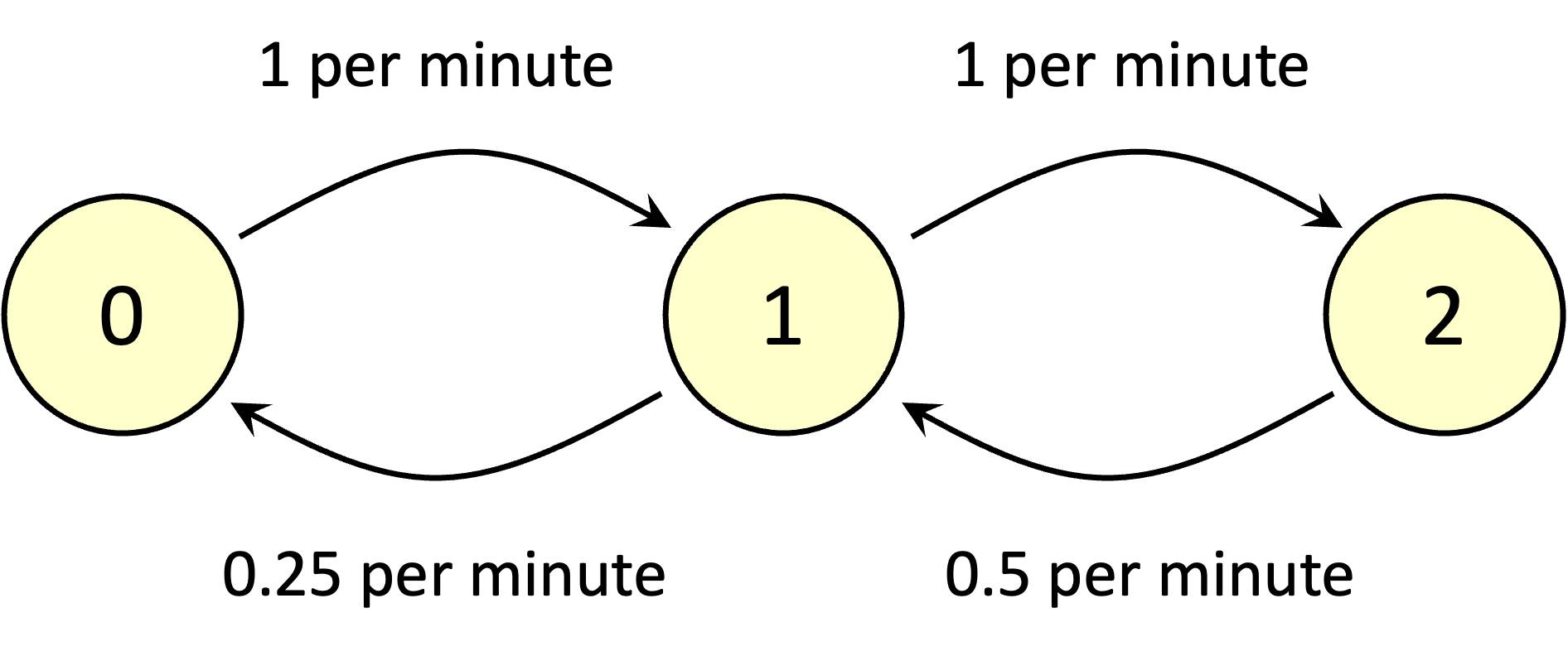
CTMC Example: Transition Rate Diagram
We can model this scenario as a Continuous-Time Markov Chain (CTMC), where the state represents the number of customers in the shop.
Thus, the possible states are: 0, 1, and 2.
We can visualize the transition rates between these states:
Time Until Next Transition
Let \(T_i\) be the time until the next transition from state \(i \in \{0, 1, 2\}\)
\(\pi_i\) gives long-run proportions of time spent in each state.
Queueing Systems as CTMCs
A queueing system (e.g., customer service desk, call center, clinic) can often be modeled as a continuous-time Markov chain, under assumptions like:
Exponentially-distributed inter-arrival times
Exponentially-distributed service times
Finite waiting area, single server, and one-at-a-time processing
Outline
Recap
Continuous Time Markov Chains (CTMC)
Lab Activity: Part 1 – CTMC (Vaccine Observation Room)
Queueing Theory
Lab Activity: Part 2 – Queueing Theory (Check-In Desk)
Lab Activity: Part 1 – CTMC (Vaccine Observation Room)
In this section, you’ll model an observation room where recently vaccinated patients are monitored for adverse events. The room has limited capacity (e.g., 2 beds).
We will use a Continuous-Time Markov Chain (CTMC) to:
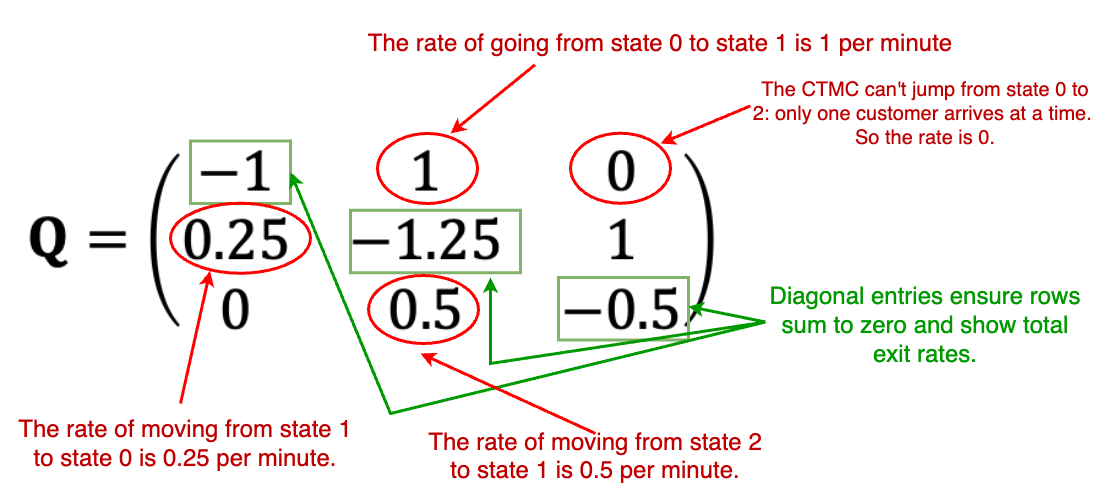
Construct the generator matrix (\(Q\))
Write and solve the steady-state equations
Interpret the long-run distribution across states
Make sure you load the required R packages: Matrix, expm
Outline
Recap
Continuous Time Markov Chains (CTMC)
Lab Activity: Part 1 – CTMC (Vaccine Observation Room)
Queueing Theory
Lab Activity: Part 2 – Queueing Theory (Check-In Desk)
Queueing Theory
Welcome to Queueing Theory!
We’ll explore how to model and analyze systems where “waiting” happens — like hospitals, call centers, and shops.
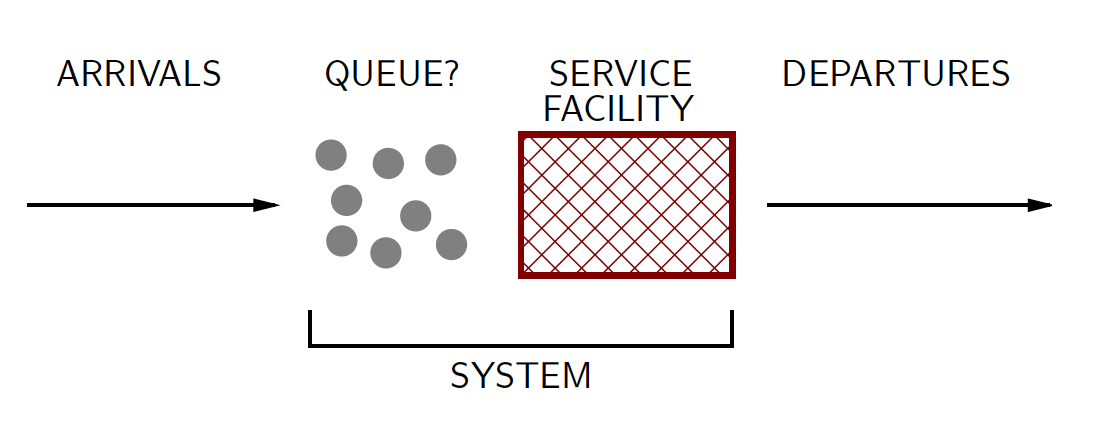
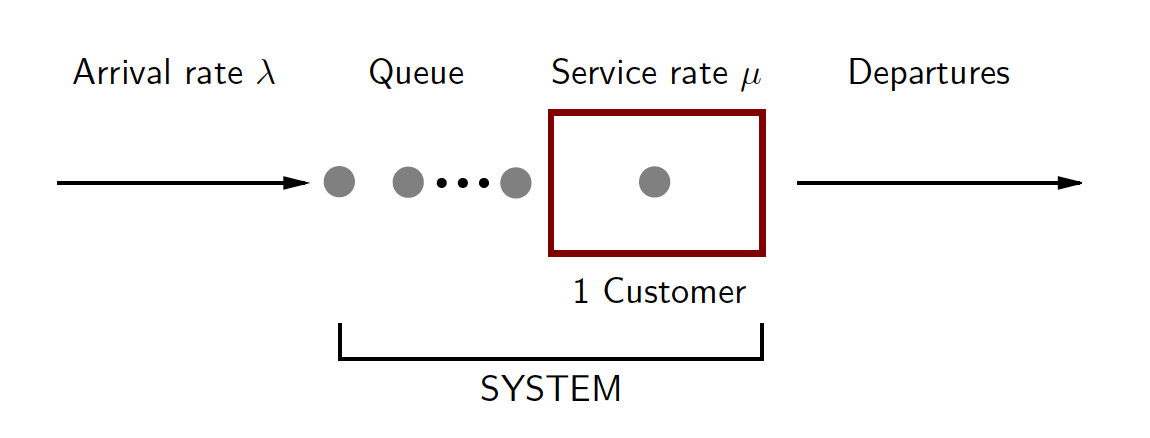
What is a Queueing System?
A system with:
Arrivals (e.g., customers, calls)
A queue (optional)
Service process (1 or more servers)
Departures
Real-World Applications
ATM and supermarket checkout lines
Call centers and helpdesks
Hospital patient flow
Computer servers and networks
Kendall’s Standard Notation
Queueing systems are described using: A/B/S/d/e
A – Arrival distribution (e.g., M = Exponential)
B – Service distribution (e.g., M, D = Deterministic, G = General)
S – Number of servers
d – System capacity (buffer size)
e – Queue discipline (e.g., FIFO, LIFO)
Example: M/M/2/5/FIFO
→ Exponential arrivals, exponential service, 2 servers,
→ Max 5 customers in system, served in order of arrival
Poisson Process
Many queueing systems assume Poisson arrivals, a key foundation for M/M/1 and related models.
This process is simple but powerful and forms the basis for most queueing models.
Definition:
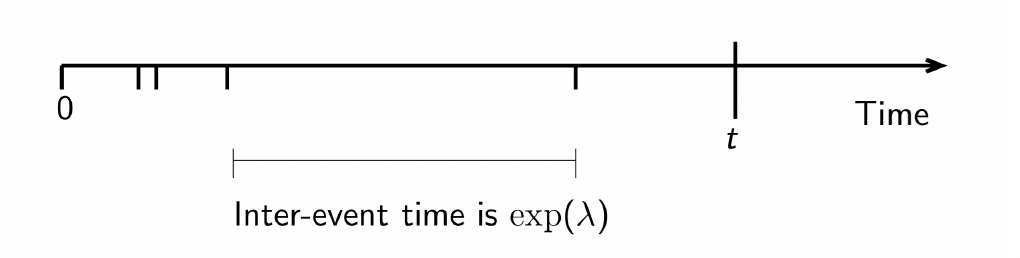
A Poisson process with rate \(\lambda\) models random arrivals over time, where:
Poisson Process Cont.
The number of arrivals in time \(t\) follows: \[
P(N(t) = k) = \frac{(\lambda t)^k e^{-\lambda t}}{k!}
\]
Interarrival times are exponentially distributed: \[
T \sim \text{Exp}(\lambda)
\]
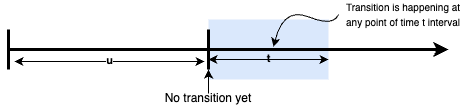
Memoryless: the probability of arrival doesn’t depend on the past
The M/M/1 Queue
A single-server queue with:
Exponential interarrival times (rate \(\lambda\))
Exponential service times (rate \(\mu\))
The number of customers in the system defines the state
The queue has infinite capacity
The M/M/1 Queue Cont.
Traffic intensity:How busy the system is?\[
\rho = \frac{\lambda}{\mu}
\]
If \(\rho < 1\), the system reaches a steady-state
If \(\rho \geq 1\), the queue grows indefinitely
\(\lambda\) = arrival rate, \(\mu\) = service rate
💡 Think of \(\rho\) as the load on the server.
If arrivals outpace service, the system can’t cope.
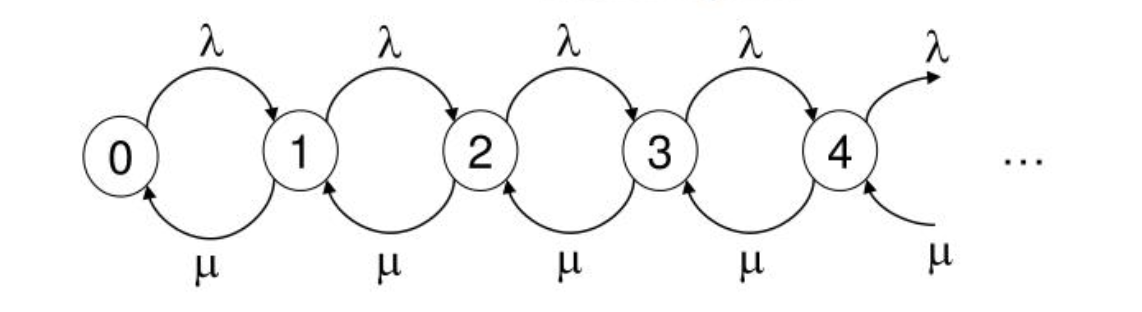
M/M/1 as a CTMC
The M/M/1 queue can be modeled as a Continuous-Time Markov Chain (CTMC).
States represent the number of customers in the system: 0, 1, 2, …
Probability the system is empty: \[p_0 = 1 - \rho\]
Probability the server is busy: \[1 - p_0 = \rho\]
Probability of \(n\) customers in the system: \[p_n = \rho^n (1 - \rho)\]
🧠 These describe the stationary distribution of the M/M/1 queue.
M/M/1: Mean Number in System (\(L\))
Expected number of customers in the system:
\[
L = \sum_{n=0}^{\infty} n p_n
= \sum_{n=0}^{\infty} n \rho^n (1 - \rho)
= \rho \sum_{n=1}^{\infty} n \rho^{n-1} (1 - \rho)
= \frac{\rho}{1 - \rho}
\]
This is one of the key performance metrics in queueing analysis.
\(L\) increases sharply as \(\rho \to 1\), showing how queues explode near capacity.
💡 Use this to inform decisions on service rates (\(\mu\)) to keep queues manageable.
Performance Measures in Queueing
Four key summary performance measures:
\(L\): Mean number of customers in the system
\(L_q\): Mean number of customers in the queue
\(W\): Mean time a customer spends in the system
\(W_q\): Mean time a customer spends waiting in the queue
Little’s Law
A fundamental relationship linking arrival rate, waiting time, and number in the system.
Mean number of customers in the system:
\[
L = \lambda W \qquad \text{($\lambda$ = arrival rate, $W$ = mean time in system)}
\]
Also:
\[
L = L_q + \frac{\lambda}{\mu} \qquad \text{(total in system = queue + in service)}
\]
Mean waiting time:
\[
W = W_q + \frac{1}{\mu} \qquad \text{($W_q$ = time in queue, $\frac{1}{\mu}$ = service time)}
\]
Mean number of customers in the queue:
\[
L_q = \lambda W_q \qquad \text{($\lambda$ = arrival rate, $W_q$ = mean time in queue)}
\]
M/M/1 Queue: Performance Formulas
Using \(\rho = \frac{\lambda}{\mu}\) and Little’s Law:
Mean number in the system: \[
L = \frac{\rho}{1 - \rho}
\]
Mean number in queue: \[
L_q = \frac{\rho^2}{1 - \rho}
\]
M/M/1 Queue: Performance Formulas Cont.
Mean time in the system: \[
W = \frac{1}{\mu(1 - \rho)}
\]
Mean waiting time in queue: \[
W_q = \frac{\rho}{\mu(1 - \rho)}
\]
Comparing M/M/1, M/M/s, and M/M/s/b
Feature
M/M/1
M/M/s
M/M/s/b
Servers
1
\(s\)
\(s\)
System Capacity
Infinite
Infinite
\(b\) (finite)
Arrival Rate (\(\lambda\))
Poisson
Poisson
Poisson
Service Time
Exponential
Exponential
Exponential
Queue Capacity
Infinite
Infinite
\(b - s\)
Blocking?
No
No
Yes (if system full)
Common Use
Basic single-server queue
Multi-server (e.g., call center)
Limited capacity (e.g., hospital beds)
Let’s Practice: Model Matching
You’ll see 3 real-world situations.
For each one, pick the most suitable queueing model:
M/M/1
M/M/s
M/M/s/b
You’ll have 30 seconds to discuss or decide for each!
Scenario 1
An emergency care unit in a district hospital has five treatment beds. Once all beds are occupied, incoming patients must be transferred to a different facility, as there is no space for waiting or holding.
Which queueing model applies?
M/M/1
M/M/s
M/M/s/b
Scenario 1 – Answer
M/M/s/b Queueing Model
- Multiple beds = multiple servers
- No waiting space = limited capacity
- Incoming patients are blocked if full
Scenario 2
A mobile vaccination clinic is staffed by a single nurse. Patients from a rural community arrive randomly and are vaccinated one at a time. If the nurse is busy, others wait in line without any restrictions on queue length.
Which model applies?
M/M/1
M/M/s
M/M/s/b
Scenario 2 – Answer
M/M/1 Queueing Model
One nurse = one server
Unlimited queue = no blocking
Standard basic queueing setup
Scenario 3
A city hospital’s diagnostic laboratory operates with four technicians. Incoming test samples are processed as soon as a technician is free. If all are busy, samples wait in a queue with no limit.
Which model applies?
M/M/1
M/M/s
M/M/s/b
Scenario 3 – Answer
M/M/s Queueing Model
Four technicians = multiple servers
Queue allowed = no blocking
Standard multi-server queue
Outline
Recap
Continuous Time Markov Chains (CTMC)
Lab Activity: Part 1 – CTMC (Vaccine Observation Room)
Queueing Theory
Lab Activity: Part 2 – Queueing Theory (Check-In Desk)
Lab Activity: Part 2 – Queueing Theory (Check-In Desk)
In this section, you’ll model the check-in desk where patients arrive and wait to be registered by a nurse.