Distributional Post-Processing for Vaccine Demand Inventory Forecasting


Udeshi Salgado, DL4SG, Cardiff University, UK
Lead Supervisor: Professor Bahman Rostami-Tabar
Co-supervisors: Dr Thanos E Goltsos, Dr Geraint Palmer, Dr Xun Wang

13 March 2026

Background
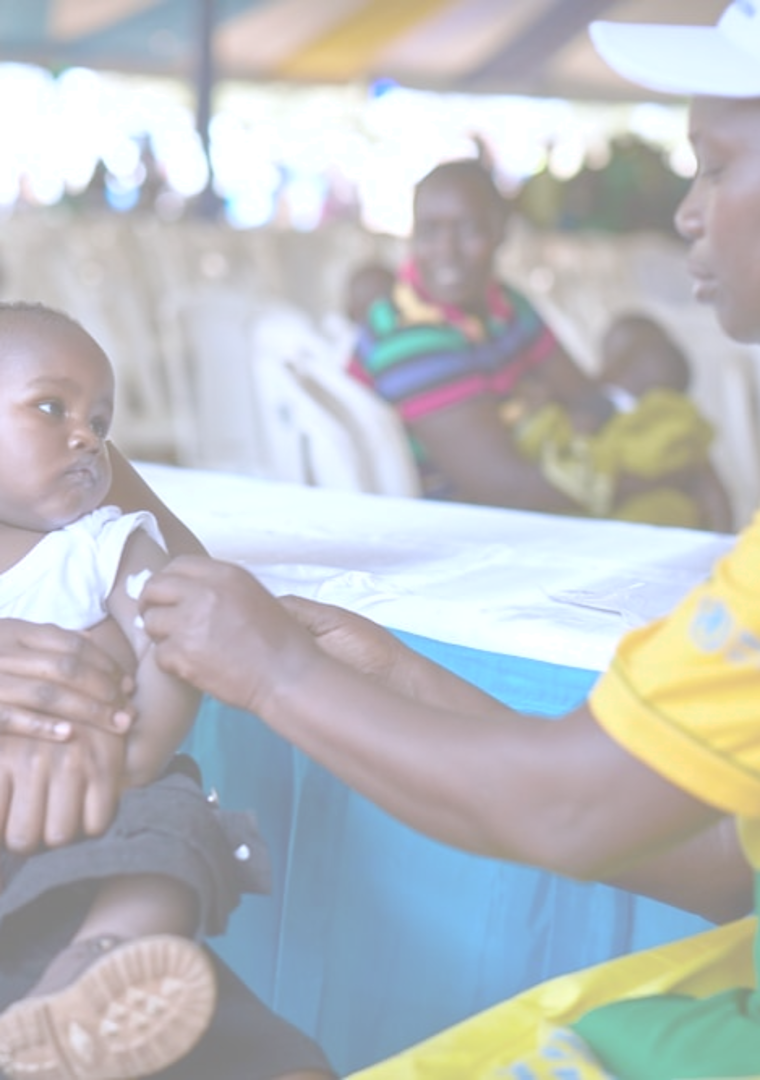
  • 1 in 5 children worldwide still lack access to essential vaccines.

  • A key operational contributor is inefficiency in vaccine supply chains.

  • In low- and middle-income countries, these inefficiencies often involve:

    • inaccurate demand forecasts
    • inventory decisions made under limited uncertainty information
    • wastage and stockouts

The Immunisation Supply Chain
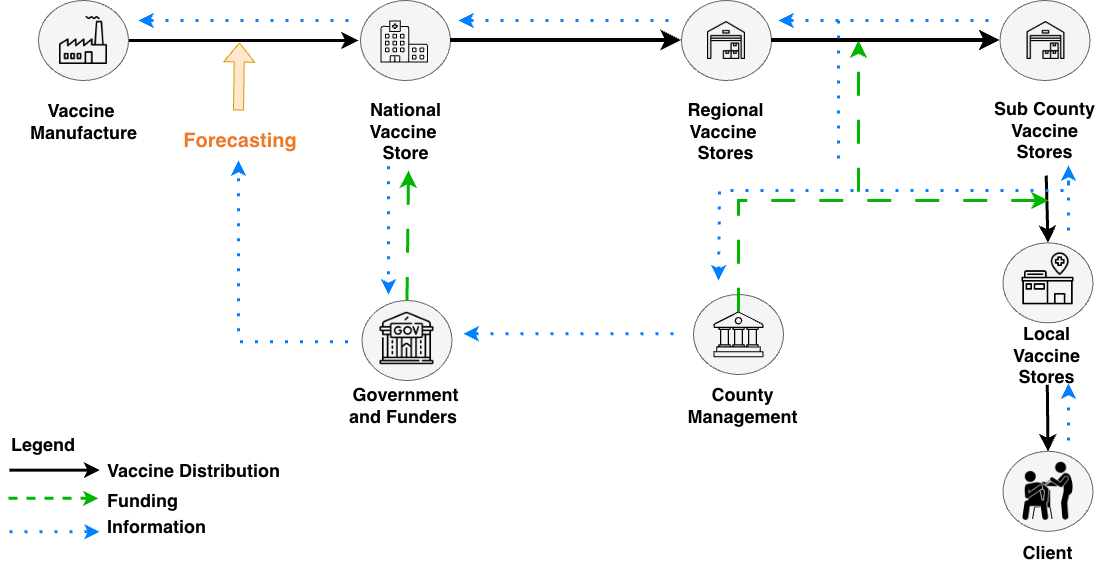
BCG (Bacille Calmette-Guérin) Vaccines


Vial

Dose

Administered

Outline

  1. Problem Statement and Motivation
  2. Decision-Relevant Forecasting under Uncertainty
  3. Forecasting Framework
  4. Distributional Post-Processing and Inventory Decision Model
  5. Results

The Problem: Evidence from the Study Setting
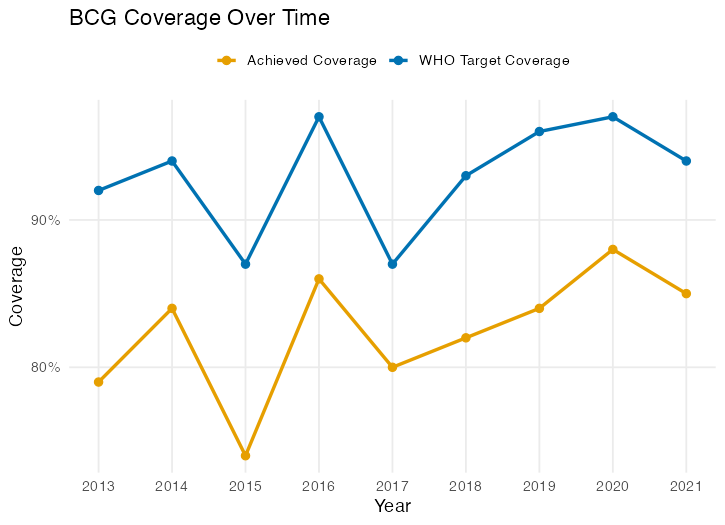
  • Coverage shown here refers to BCG vaccination coverage among newborns
  • BCG is a single-dose vaccine administered at birth
  • Coverage is defined as:

\[ \text{Coverage} = \frac{\text{No of Clients Administered}}{\text{Target Population}} \]

  • Forecasting limitations may contribute to persistent coverage gaps.

Current Forecasting Practice

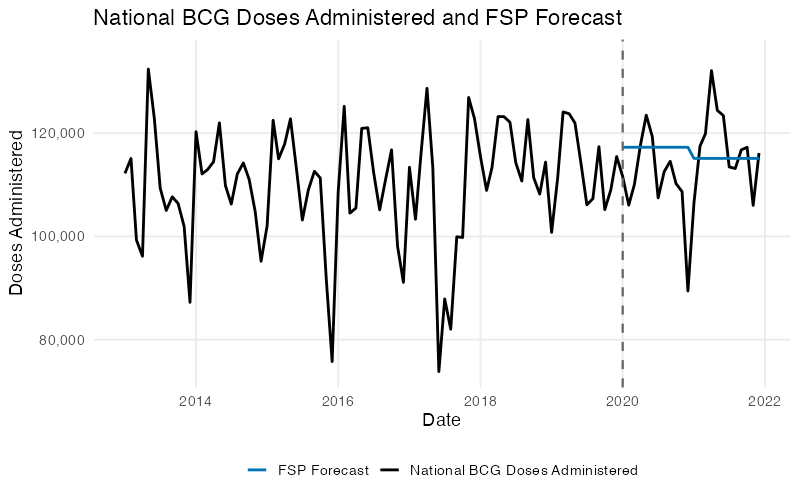
  • In practice, vaccine planning often relies on the Forecasting, Supply planning, and Procurement (FSP) Tool.

  • The FSP workflow combines three point-based planning components:

    • Demographic-based: based on demographic estimates and who static wastage and coverage rates
    • Consumption / issue-based: previous year doses administred adjusted for stockout and reporting rate
    • Session-based: 100% expert-driven planning for upcoming vaccination sessions
  • These approaches typically produce point estimates, with limited representation of uncertainty.

The FSP Forecasting

  • Forecast equation for doses administered:

    \[ \hat{D_t} = \frac{P_y \cdot C_y}{12} \]

Where:

  • \(\hat{D_t}\): Forecasted doses administered at month \(t\)
  • \(P_t\): Target population at year \(y\)
  • \(C_t\): WHO target coverage at year \(y\)

Methodological Limitations

  • In practice, vaccine planning often relies on point-based demographic planning models, limiting responsiveness to observed consumption patterns.
  • Forecasting workflows still emphasise point predictions, which do not capture uncertainty needed for operational decision-making.
  • Models trained on historical administered doses may understate true need when past delivery is supply-constrained.

Outline

  1. Problem Statement and Motivation
  2. Decision-Relevant Forecasting under Uncertainty
  3. Forecasting Framework
  4. Distributional Post-Processing and Inventory Decision Model
  5. Results

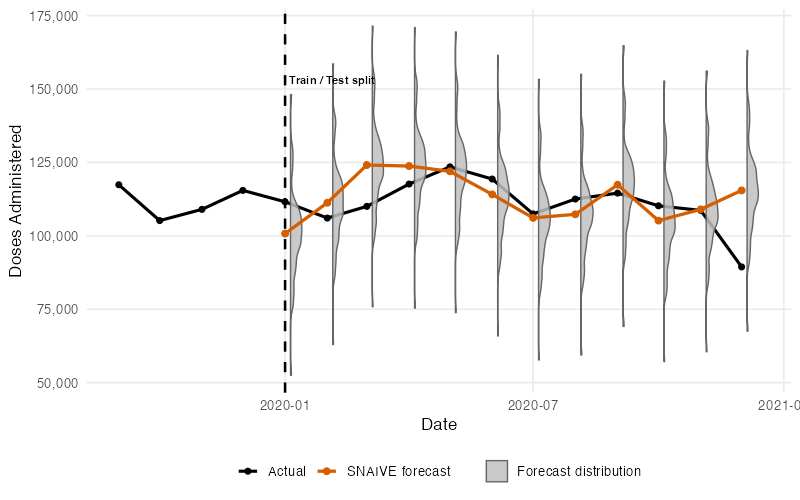
The Risk of Point Forecasting

Addressing the Uncertainty
Distributional Post-Processing: Defining Lower Bound
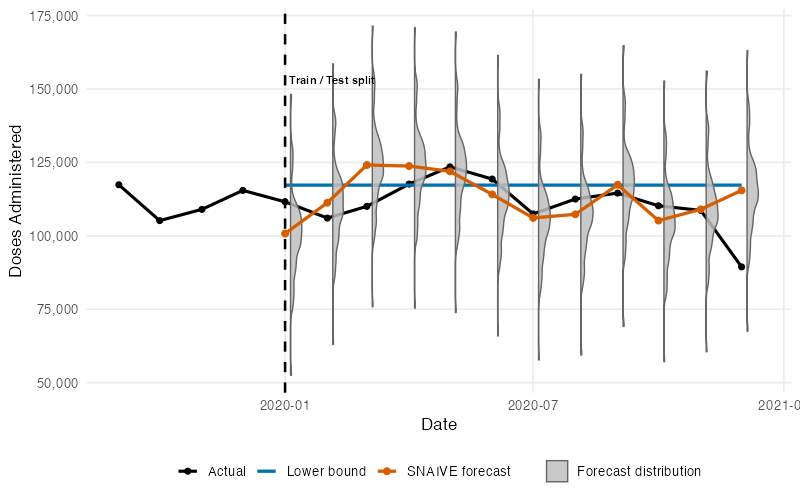
  • We define lower bound as the FSP forecast:

    \[ \text{Lower Bound} = \frac{P_y \cdot C_y}{12} \]

Where:

  • \(P_t\): Target population at year \(y\)
  • \(C_t\): WHO target coverage at year \(y\)

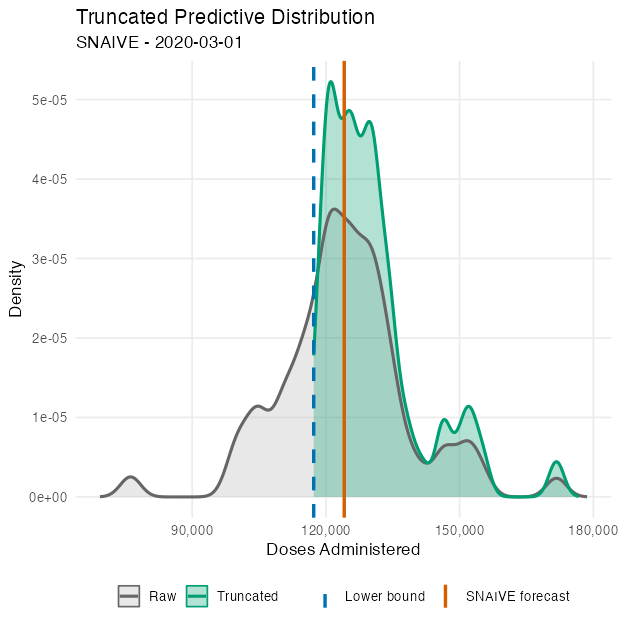
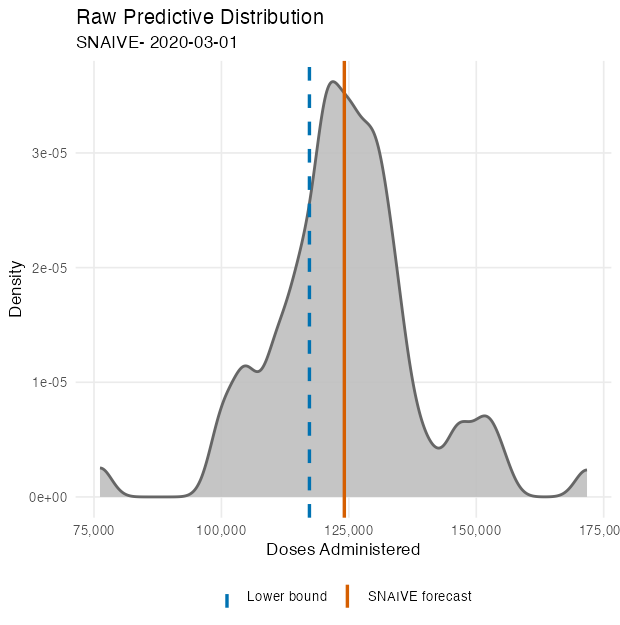
Distributional Post-Processing: Truncation
Outline

  1. Problem Statement and Motivation
  2. Decision-Relevant Forecasting under Uncertainty
  3. Forecasting Framework
  4. Distributional Post-Processing and Inventory Decision Model
  5. Results

Forecasting Framework

Data Setting

  • BCG doses administered from a LMIC country
  • Monthly data from Jan 2013 - Dec 2021
  • Hierachical Level: County Level (47 counties)
  • 48 time series in total (47 counties + national)

Forecasting Setup

  • Target variable: monthly BCG doses administsered

  • Let \(y_{i,t}\) denote administered doses
    in county \(i\) at month \(t\).

For forecast origin \(T\), predict:

\[ \{y_{i,T+1}, \dots, y_{i,T+H}\}, \quad H = 12 \]

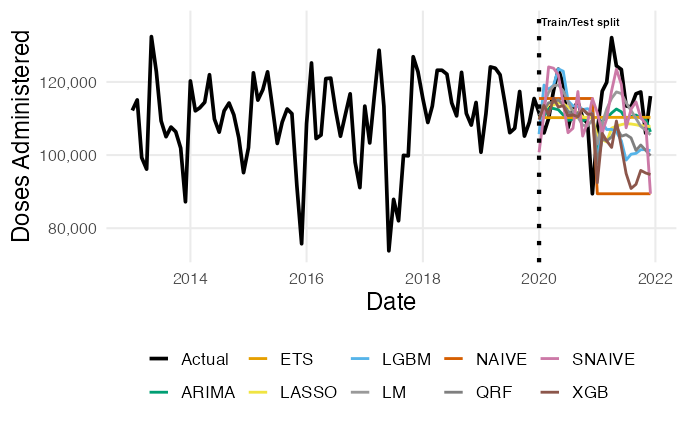
Forecasting Models

Model class Models
Classical statistical ETS, ARIMA, Naïve, Seasonal Naïve
Regression-based Linear regression, LASSO
Machine learning Quantile Random Forest, XGBoost, LightGBM
  • Each model produces multi-step point forecasts \(\hat{y}_{i,T+h|T}\).
  • Predictive distributions are obtained via blocked bootstrap residual simulation.

Outline

  1. Problem Statement and Motivation
  2. Decision-Relevant Forecasting under Uncertainty
  3. Forecasting Framework
  4. Distributional Post-Processing and Inventory Decision Model
  5. Results

Distributional Post-Processing

Raw predictive distribution

Let the predictive distribution at horizon \(h\) be

\[ p_h(y) = \Pr(Y_{T+h} = y). \]

In practice, this is approximated using blocked bootstrap residual simulation:

\[ \{y^{(1)}_{T+h},\dots,y^{(R)}_{T+h}\}. \]

Target coverage lower bound

We impose a planning-based (FSP benchmark target) lower bound:

\[ L_{T+h} = \frac{P_y \cdot C_y}{12}, \]

where \(P_y\) is the target population and \(C_y\) is WHO target coverage for year \(y\).

Conceptual truncation

The predictive distribution is truncated as:

\[ p_h^{\text{tr}}(y)= \begin{cases} p_h(y), & y \ge L_{T+h},\\ 0, & y < L_{T+h}. \end{cases} \]

and renormalized:

\[ \tilde{p}_h(y) = \frac{p_h^{\text{tr}}(y)} {\sum_{z \ge L_{T+h}} p_h(z)}. \]

  • \(p_h(y)\): raw predictive distribution at horizon \(h\)
  • \(L_{T+h}\): lower bound from target population and coverage
  • \(\tilde{p}_h(y)\): adjusted predictive distribution

Implementation (simulation)

In practice, truncation is applied to simulated draws:

\[ y^{(r),\text{tr}}_{T+h} = \begin{cases} y^{(r)}_{T+h}, & y^{(r)}_{T+h} \ge L_{T+h},\\ \text{resample from feasible draws}, & \text{otherwise}. \end{cases} \]

  • \(r=1,\dots,R\): simulation draw
  • Renormalization occurs implicitly through resampling.

Inventory Decision Model

Policy

  • Periodic-review order-up-to policy
  • Inventory reviewed monthly
  • At each review, inventory position is raised to target level (S_t)

\[ S_t = Q_{\alpha}(D_t^L) \]

  • \(Q_{\alpha}(\cdot)\): \(\alpha\)-quantile of predictive lead-time demand
  • Operationally, forecasts determine the replenishment target

Assumptions

  • Missed vaccination opportunities (no backlog)
  • Fixed lead time (L)
  • Decisions based on predictive simulations

Lead-time demand

Demand occurring while orders are in transit:

\[ D_t^{L,(r)} = \sum_{j=t}^{t+L-1} y_j^{(r)} \]

where

  • \(t\) = review period
  • \(L\) = lead time (months)
  • \(r = 1,\dots,R\) = simulation draw
  • \(y_j^{(r)}\) = simulated demand

Performance evaluation

Service measures

\[ \text{Fill Rate} = \frac{\sum_{t=1}^{T} FD_t} {\sum_{t=1}^{T} D_t} \]

\[ \text{CSL} = 1 - \frac{N_{\text{stockout}}}{T} \]

Inventory Measures

\[ \text{Average on-hand} = \frac{1}{T}\sum_{t=1}^{T} I_t \]

\[ \text{Total unmet demand} = \sum_{t=1}^{T} (D_t - FD_t) \]

where

  • \(D_t\) = demand in period \(t\)
  • \(FD_t\) = fulfilled demand in period \(t\)
  • \(T\) = total number of periods (in months)
  • \(N_{\text{stockout}}\) = number of stockout periods (in months)
  • \(I_t\) = on-hand inventory at end of period \(t\)

Outline

  1. Problem Statement and Motivation
  2. Decision-Relevant Forecasting under Uncertainty
  3. Forecasting Framework
  4. Distributional Post-Processing and Inventory Decision Model
  5. Results

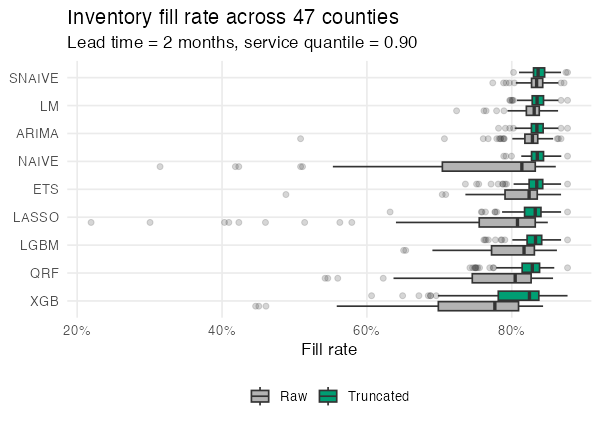
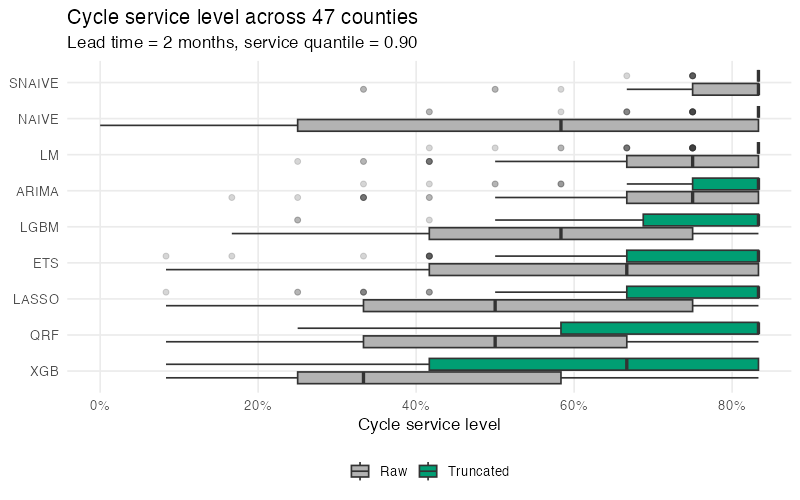
Mean Inventory Performance Across Counties

Inventory Performance Across Counties
Mean across 47 counties, lead time = 2 months, service quantile = 0.90
Fill rate
CSL
Avg on-hand
Unmet demand
Raw Trunc Raw Trunc Raw Trunc Raw Trunc
ARIMA 82.1% 83.4% 68.9% 78.5% 567 1,036 5,142 4,855
ETS 80.8% 82.9% 59.8% 73.2% 453 838 5,552 5,033
LASSO 76.1% 82.5% 51.4% 71.8% 428 840 6,774 5,212
LGBM 79.9% 82.9% 56.4% 75.2% 434 909 5,740 5,027
LM 82.7% 83.5% 71.0% 80.1% 611 1,075 5,000 4,814
NAIVE 76.1% 83.6% 54.2% 80.6% 571 1,542 6,685 4,802
QRF 77.8% 82.0% 49.7% 69.6% 366 748 6,241 5,269
SNAIVE 83.4% 83.8% 78.6% 82.5% 972 1,542 4,838 4,730
XGB 74.5% 80.0% 42.0% 59.4% 291 596 7,080 5,906

Median Inventory Performance Across Counties

Inventory Performance Across Counties
Median across 47 counties, lead time = 2 months, service quantile = 0.90
Fill rate
CSL
Avg on-hand
Unmet demand
Raw Trunc Raw Trunc Raw Trunc Raw Trunc
ARIMA 82.9% 83.5% 75.0% 83.3% 428 977 4,409 4,074
ETS 82.4% 83.4% 66.7% 83.3% 341 762 4,824 4,068
LASSO 80.8% 83.2% 50.0% 83.3% 298 732 5,363 4,198
LGBM 81.7% 83.3% 58.3% 83.3% 315 798 4,988 3,990
LM 83.1% 83.5% 75.0% 83.3% 463 932 4,225 3,985
NAIVE 81.4% 83.5% 58.3% 83.3% 303 1,152 5,322 3,985
QRF 80.5% 82.8% 50.0% 83.3% 267 636 5,178 4,447
SNAIVE 83.4% 83.6% 83.3% 83.3% 835 1,369 3,985 3,985
XGB 77.7% 82.4% 33.3% 66.7% 199 409 6,075 4,481

Connect

Udeshi Salgado

2nd year PhD Student

DL4SG, Cardiff University, UK

LinkedIn: udeshi-salgado

Slides:

Outline of my talk

  1. Problem Statement and Motivation
  2. Decision-Relevant Forecasting under Uncertainty
  3. Forecasting Framework
  4. Distributional Post-Processing and Inventory Decision Model
  5. Results