Missed in the Numbers:

Quantifying Demand Gaps in Routine Immunisation


Udeshi Salgado
Data Lab for Social Good Research Group
Cardiff Business School, Cardiff University, UK

Lead Supervisor: Professor Bahman Rostami-Tabar
Co-supervisors: Dr Thanos E Goltsos, Dr Geraint Palmer, Dr Xun Wang


2025-06-24


Outline

  1. Immunisation Supply Chain
  2. (Forecasting) Problem
  3. Methodology
  4. Model Performance Evaluation
  5. Way Forward

Background

  • 1 in 5 children worldwide lack access to lifesaving vaccines.
  • Globally, in 2023, 14.5 million children were zero-dose.
  • An additional 6.5 million children are partially vaccinated.
  • Annually, 1.5 million children under five die from vaccine-preventable diseases.

source: WHO
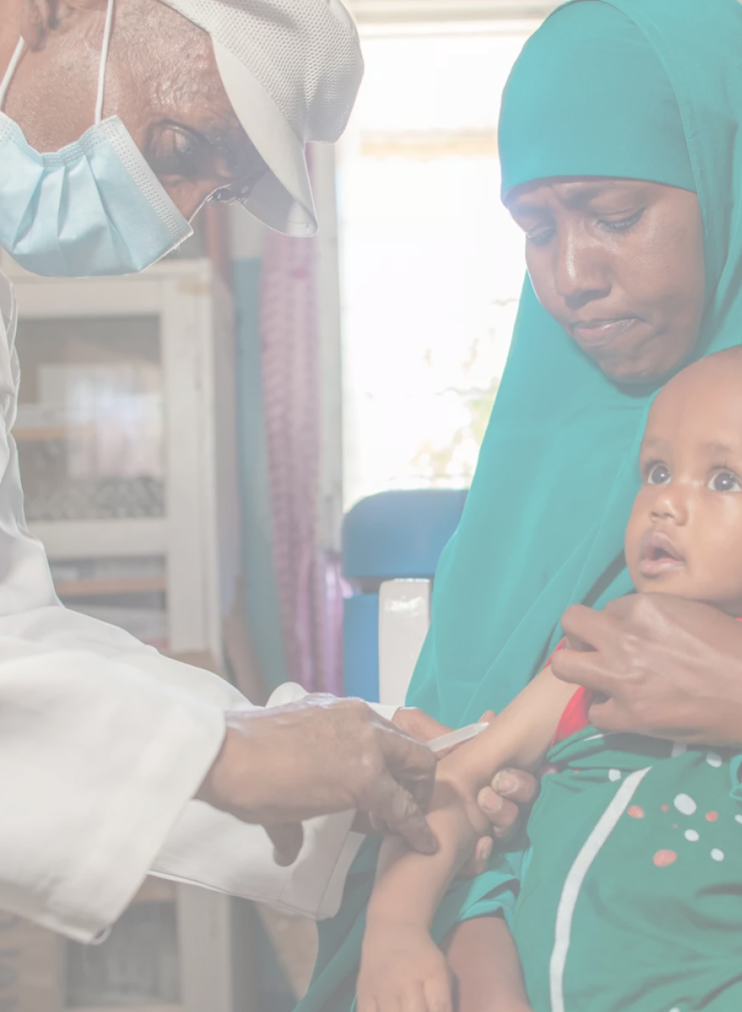
What is Routine Immunisation?

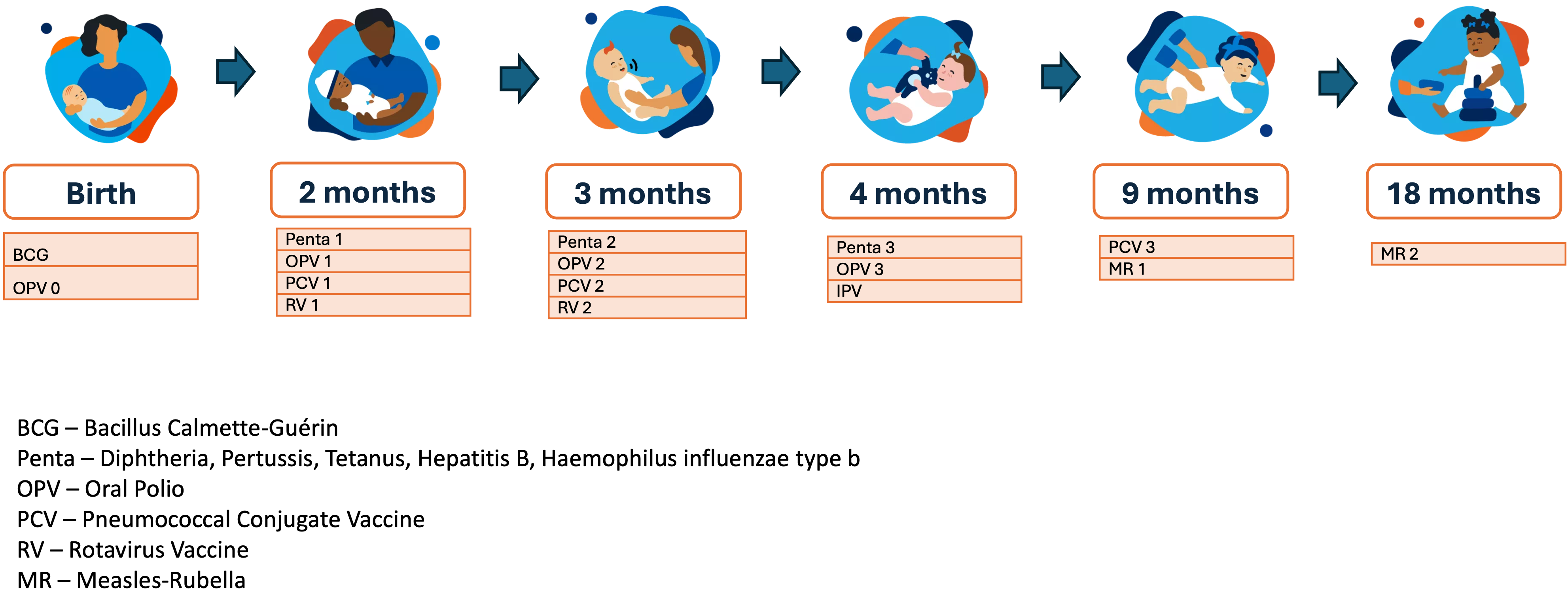
  • Regular administration of vaccines for infants, children, and adults
  • Builds population immunity and prevents disease
  • Immunisation at birth is critical
    • Newborns are highly vulnerable to severe infections
    • Delays can lead to serious illness or death

Why Routine Immunisation

  • Solving the problem at the start:
    • Fewer vaccine-preventable deaths.
    • Lower immediate and long-term costs from illness and complications.
    • Reduces future social and economic burden.
  • Each dollar spent on immunization saves $52 in low- and middle-income countries (source: CDC)

Potential Causes

  • Vaccine hesitancy and misinformation
  • Geographic inaccessibility and conflict zones
  • Weak health infrastructure and limited cold-chain capacity
  • Supply chain inefficiencies

Supply Chain Inefficiencies

  • Inadequate infrastructure
  • Weak distribution systems
  • Poor data management
  • Insufficient funding
  • Lack of trained personnel
  • Inaccurate/outdated forecasting

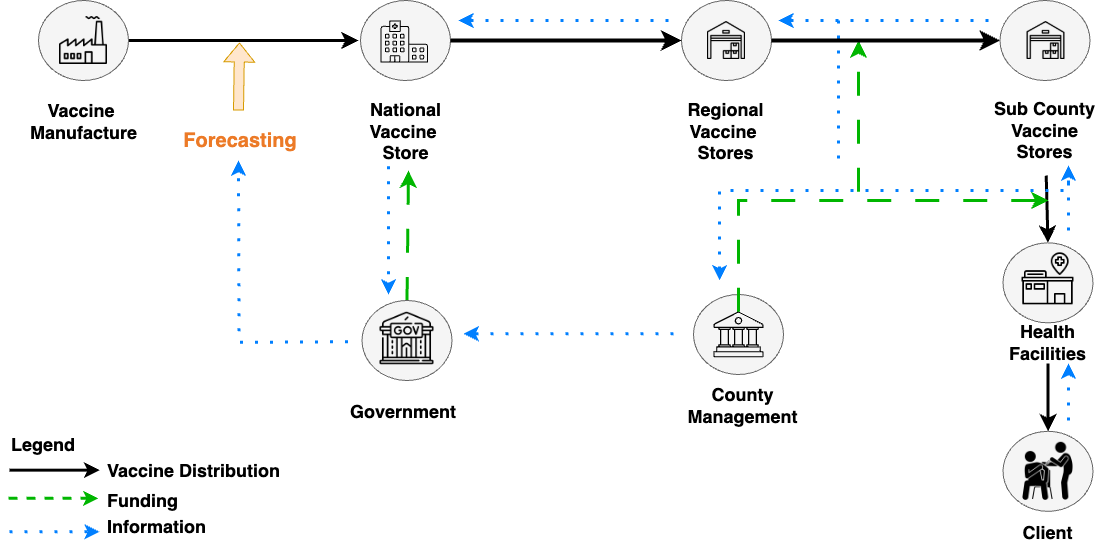
The Immunisation Supply Chain


Outline

  1. Immunisation Supply Chain
  2. (Forecasting) Problem
  3. Methodology
  4. Model Performance Evaluation
  5. Way Forward

Vaccines


Vial

Dose

Administered

Wastage
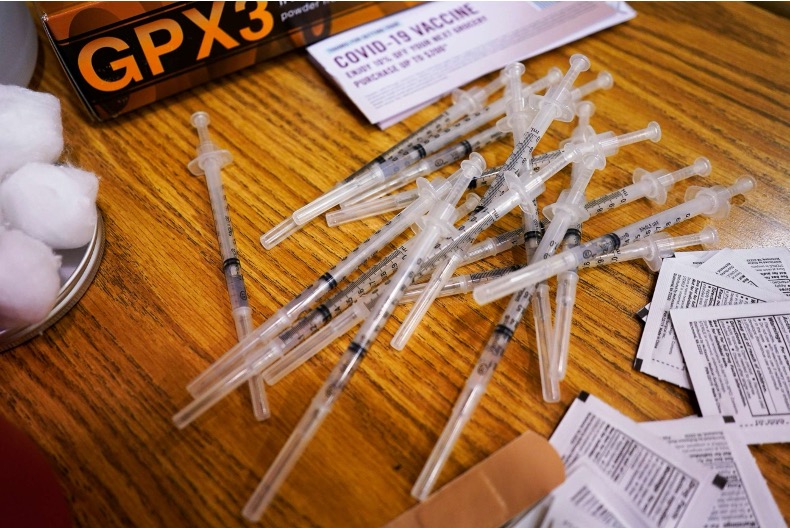

Open Vial
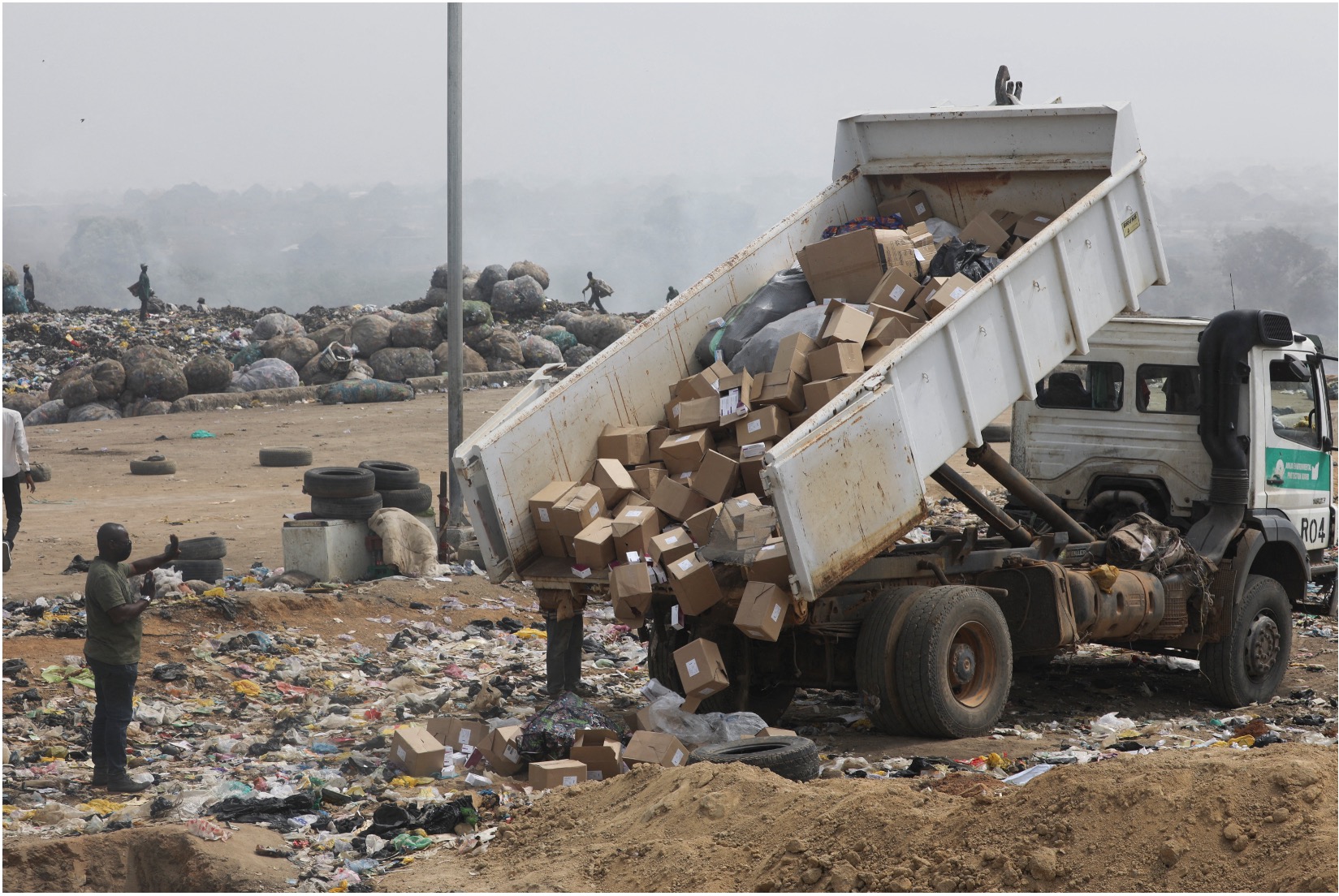
Closed Vial

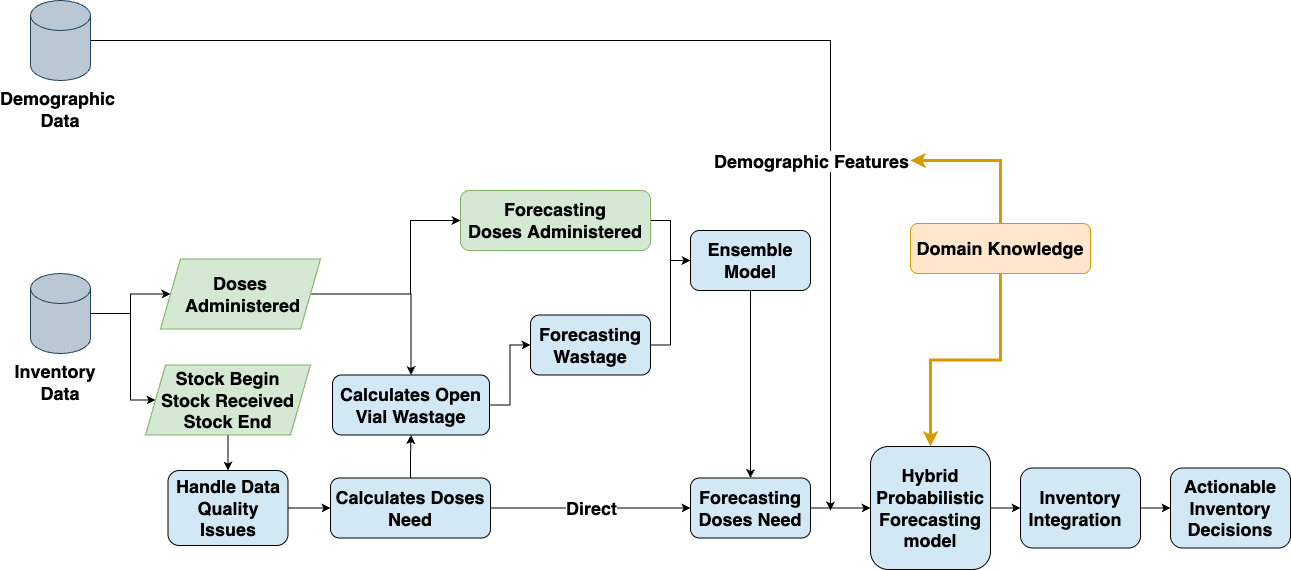
What we want to forecast?

What we want to forecast?

\[ \text{Doses Need} \quad = \quad \text{Doses administered} \quad + \quad \text{Wastage} \]

Current Approaches in Practice

  • Countries use a range of forecasting tools to support national immunisation planning and funding requests.
  • These tools are developed by global partners including UNICEF, Gavi, the Vaccine Alliance, and John Snow, Inc. (JSI).
  • The most common tools include:
    1. Expanded Programme on Immunisation (EPI) Log Tool (Incorporated in the FSP Tool)
    2. Forecasting and Supply Planning (FSP) Tool
    3. Gavi Vaccine Renewal Allocation Tool

FSP Tool: Forecasting and Supply Planning

  • Developed by UNICEF to enhance national capacity in vaccine forecasting and supply planning
  • Designed for use by national immunisation programme managers to support multi-year vaccine planning, particularly in low- and middle-income countries
  • The FSP Tool combines three forecasting methods

Forecasting Methods in the FSP Tool

The FSP Tool combines three forecasting methods for each vaccine \(i\):

1. Demographic Method
\[ \hat{D}_{\text{demographic},i,t} = \frac{P_t \cdot \text{Coverage}_{i,t} \cdot \text{DosesPerChild}_i}{1 - \text{WastageRate}_{i,t}} \]

where:

  • \(\hat{D}_{\text{demographic},i,t}\): Forecasted annual vaccine doses used demand for vaccine \(i\) in year \(t\) using demographic approach
  • \(P_t\): Target population (e.g., surviving infants) in year \(t\)
  • \(\text{Coverage}_{i,t}\): Coverage rate for vaccine \(i\) in year \(t\)
  • \(\text{DosesPerChild}_i\): Number of doses required per child for vaccine \(i\)
  • \(\text{WastageRate}_{i,t}\): Expected wastage rate for vaccine \(i\) in year \(t\)

2. Consumption-Based Method
\[ \hat{D}_{\text{consumption},i,t} = \text{AvgYearlyIssues}_{i} \cdot \frac{1}{\text{StockAvailability}_{i,t}} \]

where

  • \(\hat{D}_{\text{consumption},i,t}\): Forecasted annual vaccine doses used demand for vaccine \(i\) in year \(t\) based on consumption
  • \(\text{AvgYearlyIssues}_{i,t}\): Historical average yearly vaccine issues for vaccine \(i\)
  • \(\text{StockAvailability}_{i,t}\): Proportion of the year \(t\) vaccine \(i\) was available (i.e., no stockout)

3. Session-Based Method
\[ \hat{D}_{\text{session},i,t} = \frac{\text{Sessions}_{i,t} \cdot \text{ChildrenPerSession}_{i,t} \cdot \text{DosesPerChild}_i}{1 - \text{WastageRate}_{i,t}} \]

where:

  • \(\hat{D}_{\text{session},i,t}\): Forecasted annual vaccine doses used demand for vaccine \(i\) in year \(t\) using session planning
  • \(\text{Sessions}_{i,t}\): Number of planned vaccination sessions for vaccine \(i\) at year \(t\)
  • \(\text{ChildrenPerSession}_{i,t}\): Children vaccinated per session for vaccine \(i\) at year \(t\)
  • \(\text{DosesPerChild}_i\): Number of doses per child for vaccine \(i\)
  • \(\text{WastageRate}_{i,t}\): Expected wastage rate for vaccine \(i\) at year \(t\)

Final Forecast Combination (Hybrid Approach)

The FSP Tool combines all three forecast methods using weighted averaging:

\[ \hat{D}_{\text{final},i,t} = w_1 \cdot \hat{D}_{\text{demographic},i,t} + w_2 \cdot \hat{D}_{\text{consumption},i,t} + w_3 \cdot \hat{D}_{\text{session},i,t} \]

where

  • \(\hat{D}_{\text{final},i,t}\): Final forecasted annual vaccine doses used demand for vaccine \(i\) in year \(t\)
  • \(w_1, w_2, w_3\): Assigned weights for the demographic, consumption-based, and session-based

Gavi Vaccine Allocation and Renewal Tool

  • Developed by Gavi, the Vaccine Alliance to guide financial support for country immunisation programmes
  • Used by national governments and Gavi to estimate routine vaccine needs and determine multi-year funding allocations for Gavi-supported vaccines

Forecasting Equation Used in the Tool

For multi-dose vaccine \(i\):

\[ \hat{D}_{i,t} = \lceil \hat{SI}_t \times (d_i - 1) \times c_{i,t,1} \times (1 + w_i) + \hat{SI}_t \times c_{i,t,2} \times (1 + w_{i,t}) \times \left(1 + \frac{b_{i,t}}{12}\right) \rceil \]

Where:

  • \(\hat{D}_{i,t}\): Forecasted annual vaccine doses used demand for vaccine \(i\) in year \(t\)
  • \(\hat{SI}_t\): Estimated surviving infants in year \(t\)
  • \(d_i\): Total doses required per child for vaccine \(i\)
  • \(c_{i,t,1}\): Coverage of the first dose of vaccine \(i\) at year \(t\)
  • \(c_{i,t,2}\): Coverage of the last dose of vaccine \(i\) at year \(t\)
  • \(w_{i,t}\): Vaccine wastage rate of vaccine \(i\) at year \(t\)
  • \(b_{i,t}\): Buffer stock duration in months for vaccine \(i\) at year \(t\)

Comparison of Forecasting Tools

Tool Output.Variables Input.Variables Forecast.Horizon Time.Granularity Forecasting.Method Vaccines.Targeted
FSP (Forecasting and Supply Planning) Tool
FSP Tool – Demographic Method Forecasted vaccine doses based on population targets Population growth, birth cohort, surviving infants, wastage rate, doses per schedule 3–5 years Yearly Demographic BCG, Penta, OPV, Measles, PCV, Rotavirus
FSP Tool – Consumption-Based Method Forecasted vaccine doses based on historical usage adjusted for stockouts Average yearly consumption, stockout days, wastage 3–5 years Yearly Consumption-based BCG, Penta, OPV, Measles, PCV, Rotavirus
FSP Tool – Session-Based Method Forecasted vaccine doses based on planned session activity Session frequency, population per session, attendance rate 3–5 years Yearly Session-based BCG, Penta, OPV, Measles, PCV, Rotavirus
Gavi Allocation and Renewal Tool Annual forecasted vaccine doses used for funding allocation Surviving infants, coverage (1st/last dose), wastage, buffer stock 5 years Yearly Demographic Penta, Measles, PCV, Rotavirus

Literature Review

Reference Method Variable Inputs Time Horizon Hierarchical Level Probabilistic Metric
Chiu et al. (2008) ARIMA, BPNN, ARIMAT Total annual vaccine demand Historical births, doses, wastage, CDC rules Annual 1 year Yes Regional No Average error rate
Kotagiri et al. (2011) Birth pop.-based model Births Early birth info NA NA No Local No Impact on vaccine inventory levels
Mueller et al. (2016) Pop.-based model Quantity of vaccines needed Scaled census cohort data Monthly 12 months Yes Local No Vaccine availability, Missed Vaccination Opportunities (MVO)
Azadi et al. (2018) Regression models Childhood immunization demand Population size, poverty, literacy, clinics Monthly NA No Regional No Not available
Cernuschi et al. (2018) Pop.-based model BCG vaccine demand UNPD forecast, EPI schedule, WHO coverage/wastage Annual 14 years No National No Comparison with historical procurement
Alegado & Tumibay (2020) ARIMA, MLPNN BCG vaccine demand Monthly vaccination data Monthly 12 months No Local No RMSE, MAE
Colrain et al. (2020) Stat./Probabilistic (Binomial) Expected doses used/wastage Birth cohort, sessions, vials, discard time Annual 1 year Yes Local Yes Wastage rate comparison, sensitivity analysis
Hariharan et al. (2020) RFR Vaccine utilization Health facility data, date parts, rolling avg. Biweekly NA No Local No Forecasting error (FE), RMSE
Sahisnu et al. (2020) ARIMA Vaccine stock levels Stock history data Monthly 10 months No Local No MAPE
Vinitha et al. (2024) LR, RF, GBM, SVR, LSTM, ANN Infant vaccination demand Vaccine name, district, intake date Monthly NA No Local No RMSE, R-Square

Literature Review Cont.

Reference Method Variable Inputs Time Horizon Hierarchical Level Probabilistic Metric
Alegado & Tumibay (2020) ARIMA, MLPNN BCG vaccine demand Monthly vaccination data Monthly 12 months No Local No RMSE, MAE
Colrain et al. (2020) Stat./Probabilistic (Binomial) Expected doses used/wastage Birth cohort, sessions, vials, discard time Annual 1 year Yes Local Yes Wastage rate comparison, sensitivity analysis
Hariharan et al. (2020) RFR Vaccine utilization Health facility data, date parts, rolling avg. Biweekly NA No Local No Forecasting error (FE), RMSE
Sahisnu et al. (2020) ARIMA Vaccine stock levels Stock history data Monthly 10 months No Local No MAPE
Vinitha et al. (2024) LR, RF, GBM, SVR, LSTM, ANN Infant vaccination demand Vaccine name, district, intake date Monthly NA No Local No RMSE, R-Square

What is Missing?

  • Tools in practice mainly use population-based forecasting.
  • FSP tool combines methods, but weighting is subjective.
  • Academic models: mostly population or consumption-based, rarely both.
  • No unified model combining population and consumption data.
  • Forecasts rarely inform inventory decisions in practice.

What we want to achieve?


High Coverage of the Doses Administrated

✅ Reduce missed opportunities

✅ Accounting for accurate wastage rate

✅ Data-driven buffer stock

✅ Forecasting + inventory integration

Research Questions

RQ1: What is the most suitable consumption-based forecasting model for routine vaccine demand at national level?

RQ2: How can population-based features be effectively combined with consumption-based models to improve forecast accuracy and quantify uncertainty?

RQ3: How can improved probabilistic forecasts be integrated into inventory decision-making for better vaccine supply chain management?


Outline

  1. Immunisation Supply Chain
  2. (Forecasting) Problem
  3. Methodology
  4. Model Performance Evaluation
  5. Way Forward

Data

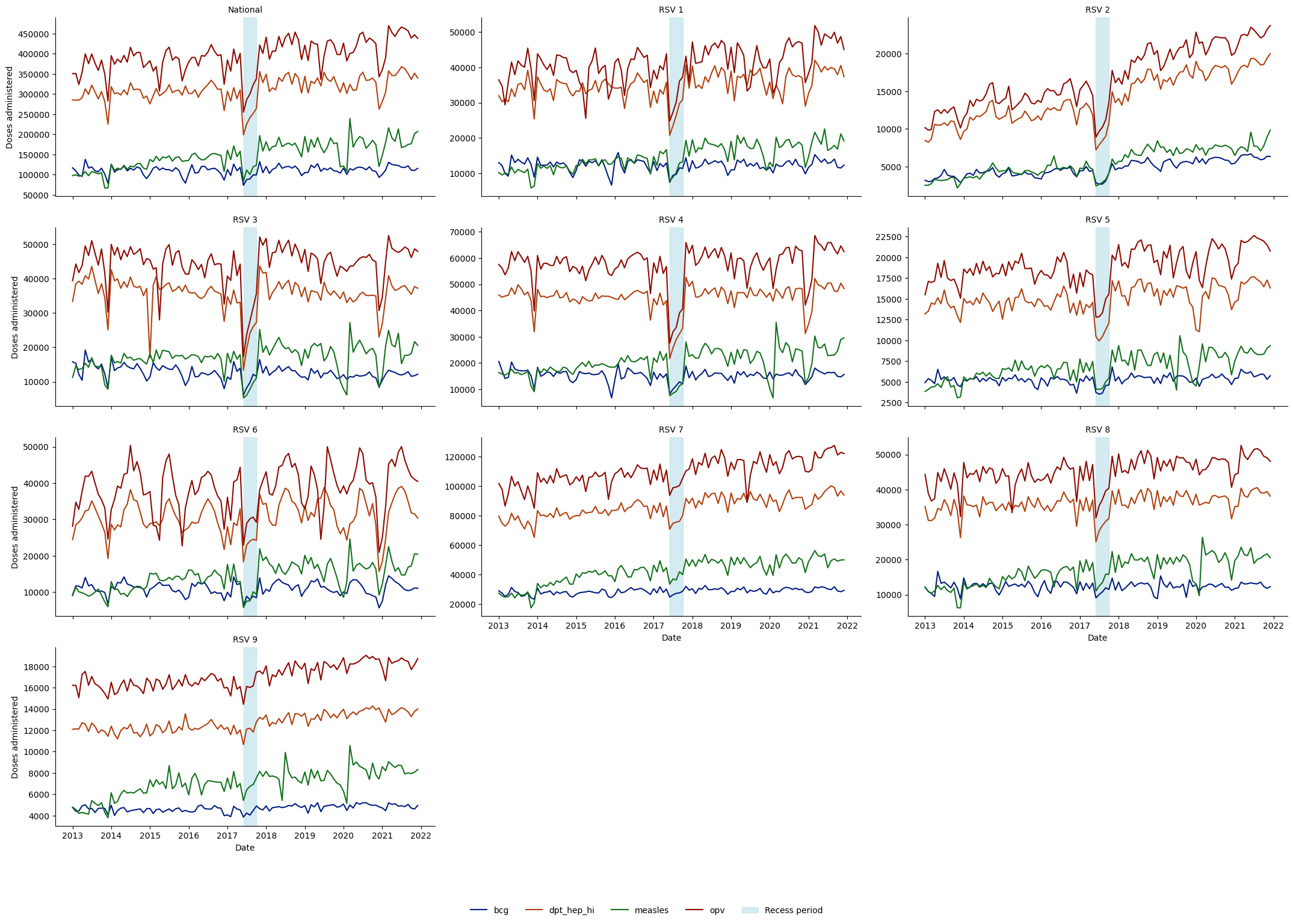
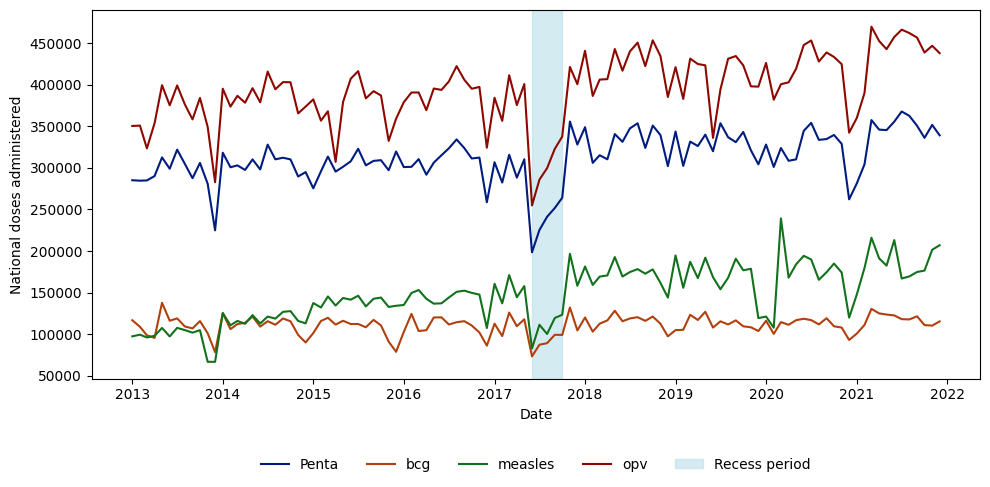
  • Vaccine consumption data from an African country (Jan 2013 – Dec 2021)
  • Four vaccines:
    • Measles~rubella
    • BCG – for tuberculosis
    • Penta – combination vaccine for diphtheria, tetanus, pertussis, hepatitis B, and Hib
    • OPV – oral polio vaccine

Data Structure

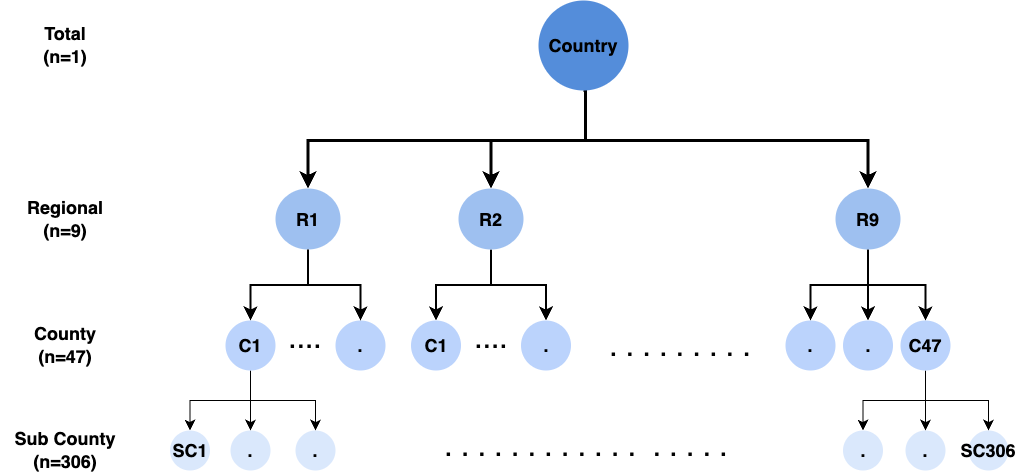
Doses administrated: National and Regional
Doses administrated: National
Forecasting Setup

  • Forecasting methods: Seasonal Naive, ARIMA, ETS, Linear Regression, Gradient Boosting (GBM, quantile regression)
  • Forecast horizon: 12 months
  • Target: Doses Administered
  • Cross-sectional training across vaccines with monthly data, using an expanding window approach

Performance Evaluation Metrics

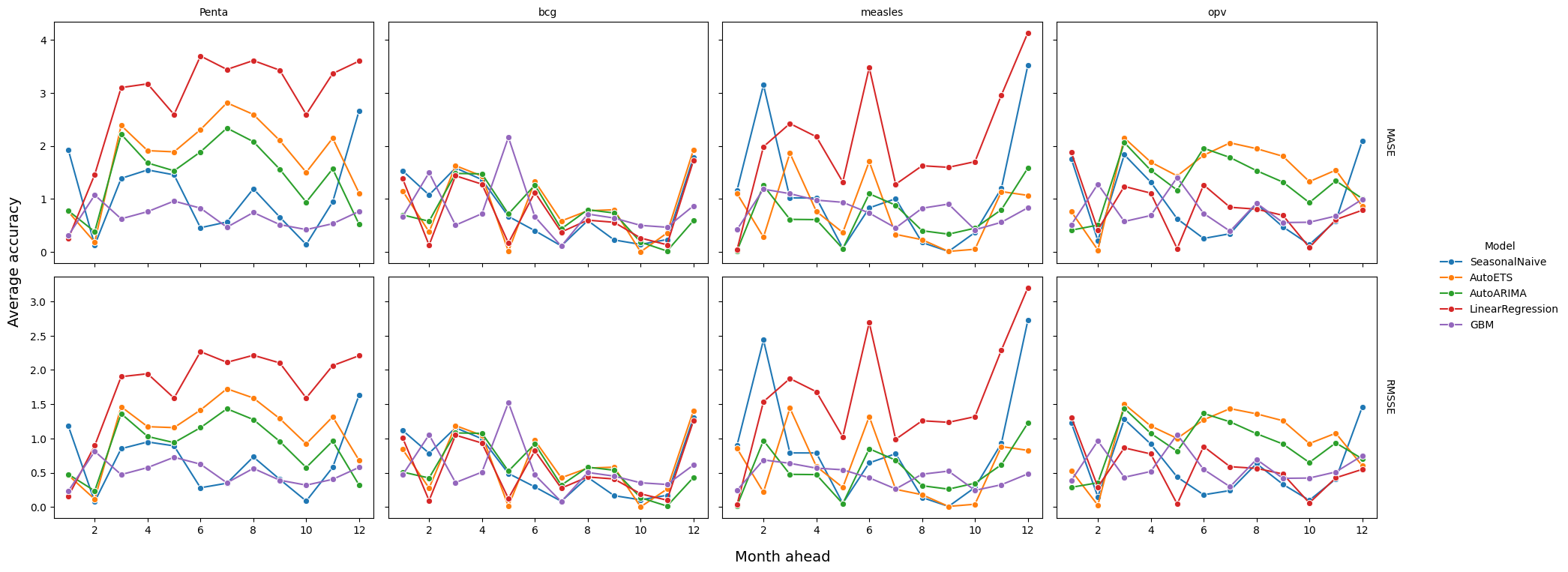
Root Mean Squared Scaled Error (RMSSE):

\[ \text{RMSSE} = \sqrt{ \text{mean}(q_j^2) } \]

where

\[ q_j^2 = \frac{e_j^2}{\frac{1}{T-m} \sum_{t=m+1}^{T} (y_t - y_{t-m})^2} \]

Mean Absolute Scaled Error (MASE):

\[ \text{MASE} = \text{mean}(|q_j|) \]

where

\[ q_j = \frac{e_j}{\frac{1}{T-m} \sum_{t=m+1}^{T} |y_t - y_{t-m}|} \]


Outline

  1. Immunisation Supply Chain
  2. (Forecasting) Problem
  3. Methodology
  4. Model Performance Evaluation
  5. Way Forward

Performance Metrics

BCG

Model MASE RMSSE
AutoARIMA 0.7479 0.5460
LinearRegression 0.7649 0.5584
GBM 0.7888 0.5556
SeasonalNaive 0.8105 0.5916
AutoETS 0.8651 0.6315

Penta

Model MASE RMSSE
GBM 0.6672 0.5046
SeasonalNaive 1.0888 0.6681
AutoARIMA 1.4564 0.8937
AutoETS 1.8076 1.1092
LinearRegression 2.8568 1.7530

Measles~Rubella

Model MASE RMSSE
AutoARIMA 0.6762 0.5235
AutoETS 0.7434 0.5756
GBM 0.7562 0.4385
SeasonalNaive 1.1277 0.8731
LinearRegression 2.0586 1.5939

OPV

Model MASE RMSSE
GBM 0.7442 0.5609
LinearRegression 0.8162 0.5696
SeasonalNaive 0.8791 0.6135
AutoARIMA 1.2962 0.9046
AutoETS 1.4534 1.0143

Model Performance Over Forecast Horizon

Outline

  1. Immunisation Supply Chain
  2. (Forecasting) Problem
  3. Methodology
  4. Model Performance Evaluation
  5. Way Forward

Next Steps


Acknowledgement

  • John and Snow Inc (JSI) team
    • Dr. Laila Akhlaghi
    • Wendy Prosser

About me


Udeshi Salgado

1st year PhD Student

DL4SG, Cardiff University, UK


LinkedIn: udeshi-salgado

Slides: udeshisalgado.github.io/talks

Outline of my talk


  1. Immunisation Supply Chain
  2. (Forecasting) Problem
  3. Methodology
  4. Model Performance Evaluation
  5. Way Forward